Alright, I’m getting back on the backlog board in 2024! As part of the massive gaming gaps in my deprived youth, I am ashamed to admit I’ve never touched a final fantasy game. I had only one (not very close) friend who was going through FF6 in middle school so I was only ever briefly exposed to it while it was at its peak.
And because I like to go in completely blind to new games and media, I’ve never read about the series either. All I knew was that it’s a highly acclaimed RPG with turn based combat, and that most kids that grew up with FF6/7/8 raved about the story.
I’d always intended to try to play through these, but hadn’t taken the time to search for a package deal or dive back into emulator downloads. So when @bg-admin Johnny gifted me a great little handheld emulator preloaded with hundreds of old NES, Nintendo, Gameboy and GBA games, as soon as I spotted Final Fantasy 1 and 2 on there I knew the time had come.
[Side note, being gifted an emulator with 500+ games doesn’t count as a +500 for backlog golf right? I mean, that wouldn’t be right. But then, does beating a gifted game count for a -1? JUDGE!]
Alright, Final Fantasy 1 – going in completely blind, almost 40 years after its release [1987].
I should note that the copy I’m playing is a re-release that has some quality of life improvements from the original.
Still, the first thing that struck me when I started playing was how smooth the game felt. Moving around the world is clear and easy to navigate, the pixel art of both the world and the characters holds up really well, and the combat is quick to get into and doesn’t feel clunky.
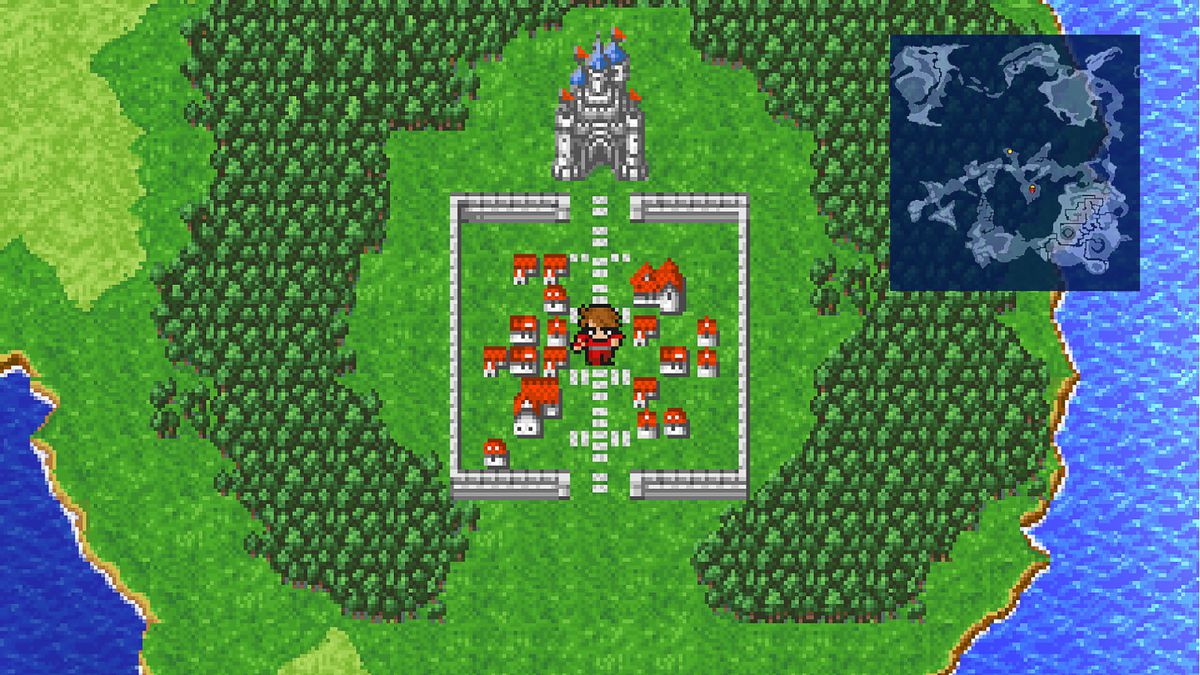
Welcome to Cornelia! Entering the world you can immediately visit the town and get a feel for the main stores you’ll interact with in every town: An Inn where you can rest your party, restoring them to full health/mana, a shop for weapons, a shop for armour, a shop for black magic (offensive), a shop for white magic (healing), a potion shop for consumables, and a cathedral where you can resurrect dead party members. Cornelia also contains a castle which you can enter separately from the town, a feature most other towns in the world don’t have. As you progress, each town has more advanced weapons, armour, potions and spells, so they act as a nice consistent reward point where each new one you discover opens up improvements for your character as well as new quest points.
You can poke and prod the townsfolk, most will give you a single repeating line of dialogue, but exploration is rewarded here and there with clues about your quests and surroundings. Once you find your way into the castle the king pretty much lays everything out for you – he’s hunting for four warriors of light who are carrying the crystals of light. Your characters are really excited to hear this, because I’ll be damned, they all seem to be carrying crystals, which they begin waving in the air.

The king thanks the universe for finally sending you and then promptly sends you off the save his daughter to warm up your hero skills.
From here you’re left to wander around the world as you please. The opening area is fairly small, all bordered by water, which you can’t enter at this point, so you’ll find your way to the enemies castle and be able to rescue the princess in short order. Upon returning the king will reward you by repairing a key bridge to the adjacent island, which has apparently been broken for centuries but could be fixed in a few seconds once the King throws a little cash at his soldiers.
Once the bridge is repaired, the world opens further and you start to be presented with a fairly large landscape populated by forests, deserts and seas, with towns scattered all around along with caves which mostly contain multi level dungeons, but are occasionally populated by dwarves and mystics. As you adventure the story will progress through key items you discover or fight your way to, which must either be brought to the right character, or used in some way to open up new sections of the map.
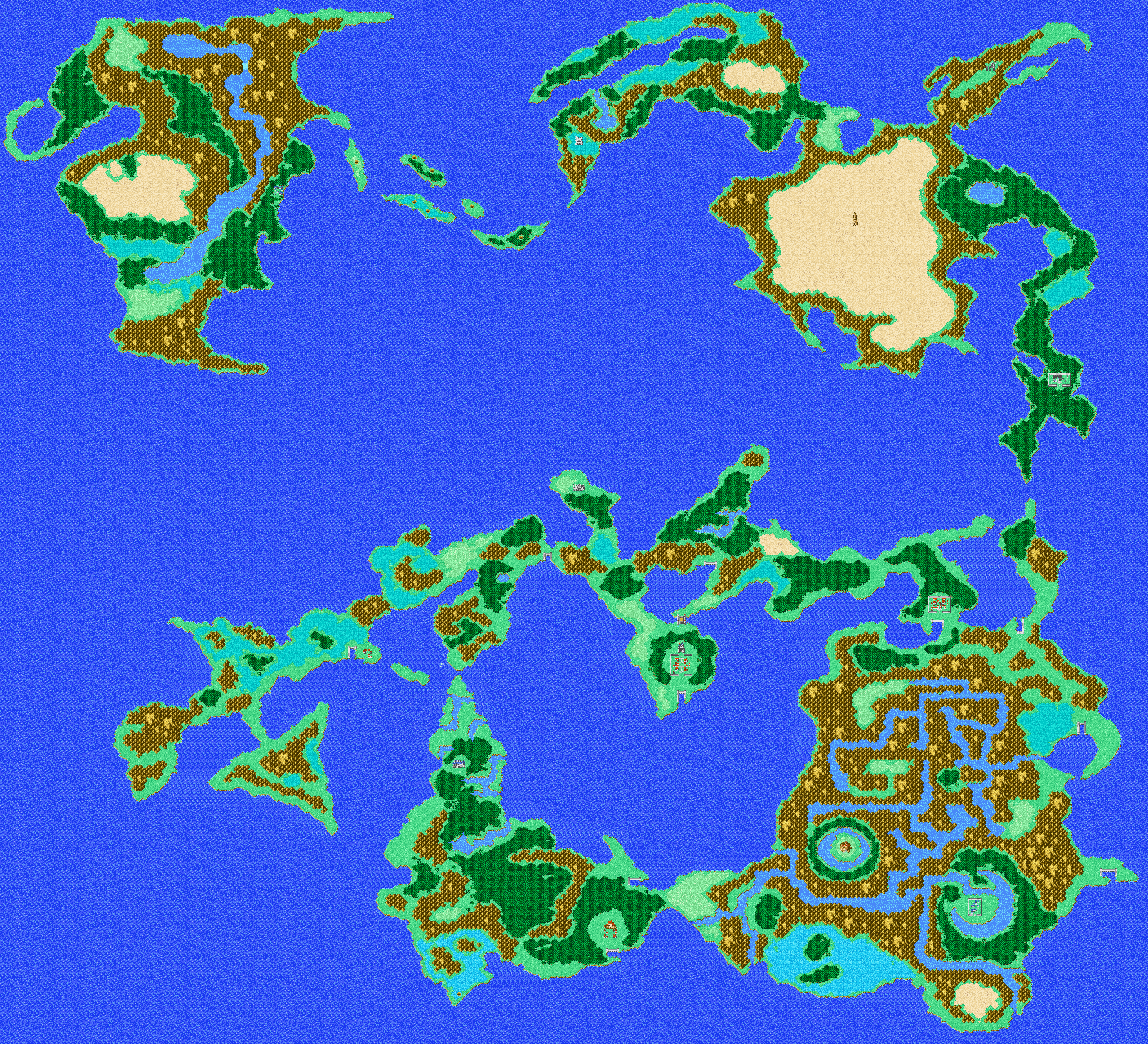
The game gives you the structure of a core mission: find the four fiends who are corrupting the crystals representing Water, Fire, Earth and Wind. Each one you defeat adds their crystal to your inventory.
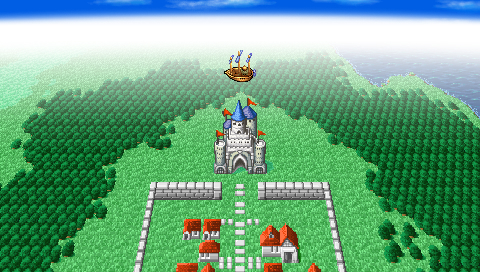
Part of the map design is structured around gaining new means of transportation – first a boat allows you to start crossing the sea and searching for ports, then a canoe allows you to begin navigating rivers within land masses, and finally you gain an air ship (with a wild 3D effect attached to it) which allows you to quickly and freely navigate the whole world.
I was impressed with this element in the level design, and as I played through the game, I kept feeling struck by how many core elements of the pokemon system existed in this game way back in 1987. Unlocking new map sections through vehicles or story progression, random encounters with enemies as you move about the wilds (more on that later), the whole system of turn based combat where you can use potions, spells or attacks, the cute little towns scattered around the world populated by a bunch of single-dialogue npcs. All the bones are there, outside the monster collection system.
The unlocking areas system isn’t as polished as a Pokemon game, where you can see things in early towns that may not unlock until much later, giving you layers of exploration that’s well teased and has good payoffs, but you will enjoy unlocking new towns and you will sometimes return to earlier ones.
I was also impressed with the sheer number of enemies they made artwork for. No matter how far I got, it seemed like every piece of cave I explored presented me with something new. The sheer volume of cool pixelart put into this game is pretty wild, even though they recycle a lot with colour alterations indicating higher level versions of similar enemies.
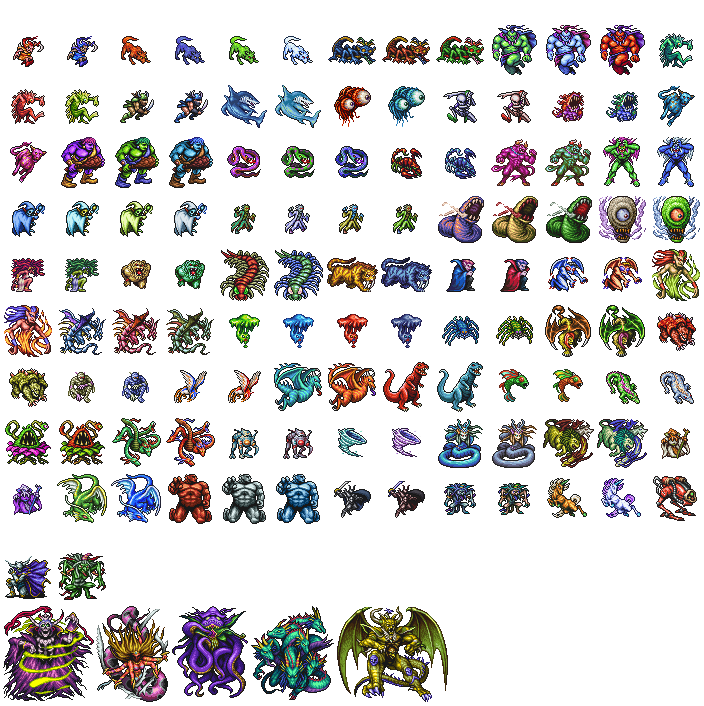
All of that being said, as someone playing the game as an adult, 37+ years after its release, with no nostalgia for the experience, there was one fatal flaw to the game: the wild areas trigger way too many random encounters, and all of the random encounters are much, much too easy.
I began the game slowly, trying to learn the abilities of my characters, carefully picking their upgrades and spells, and trying to maximize effectiveness in combat by understanding how much damage each character would deal and which enemies were more threatening.
But all of that effort was in vain. While the game has the bones of a great combat system, 99% of the enemies you see above, outside of the bosses, are effectively the same. In the very early game your characters will take enough damage that you may have to retreat to a town to reload with potions a few times on your way through a dungeon, but by the middle game the enemies are so hopelessly outclassed that you end up dreading triggering an encounter as you move around, not because you’re scared of dying, but because the encounters aren’t challenging or interesting. I remember occasionally feeling this way in Pokemon when backtracking through an early wild area, but never to this degree.
By mid/late game, most of these encounters consisted of 5 enemies dealing 1 damage each to my warrior, who had 650+ health, maybe 20 damage to one of my mages (also with 500+ health), and then my warrior swinging back for 600-900 damage, instantly killing whoever his target was.
Once I realized that if I targeted the same monster with my whole parties attacks the attacks would automatically move to the next target once the first target died (no overkill/wasted attacks) I started literally mashing the A button 8 times for every encounter. It was the fastest way to make enemy go away. It was disappointing and frustrating – the artists had produced a deep roster of cool enemies, but the game designers had failed to make them interesting.
The game wasn’t without its challenges. The bosses were generally challenging and interesting, and the optional monster bosses could be damn near impossible. I was excited every time I found one as it was the only time I had to really use any of the dozens of interesting potions and items I’d collected and carefully think about how to use protection/healing and buff/debuff spells.

And as you’d expect in games like this, finding all the right items and getting them to the right places was also challenging, and I did turn to a walkthrough a few times to get on track when it seemed like I’d spoken to everyone and gone to every dungeon. Some of the puzzles are super basic (i.e: there’s a dungeon level near the finale where you just have to walk back and forth among 10 dwarves trading items they need between them) but I was generally impressed by how much work was put into building an expansive world that you could spend hundreds of hours working through to get to every object.
Over the course of the game you’ll meet giants, dwarves, wizards and elves, you’ll plumb the depths of volcanoes and dragon caves, meet lost princesses and sleeping princes, get to fly across the land to find towns hidden in the mountains, blocked off from the world, and finally save the world from hundreds of years of corruption – the child version of me definitely would’ve loved this game.
And it remains a beautiful game – I’ll give it an 8/10 for respect for what it was in its time, but a 4/10 to modern players – the combat encounters just dominate the time you’ll spend on this game and they end up being a frustrating slog. I’d only recommend playing this if you grew up with it, or you’re like me and just want to experience a historically important gaming series first hand and are willing to accept the challenges that come with that.